

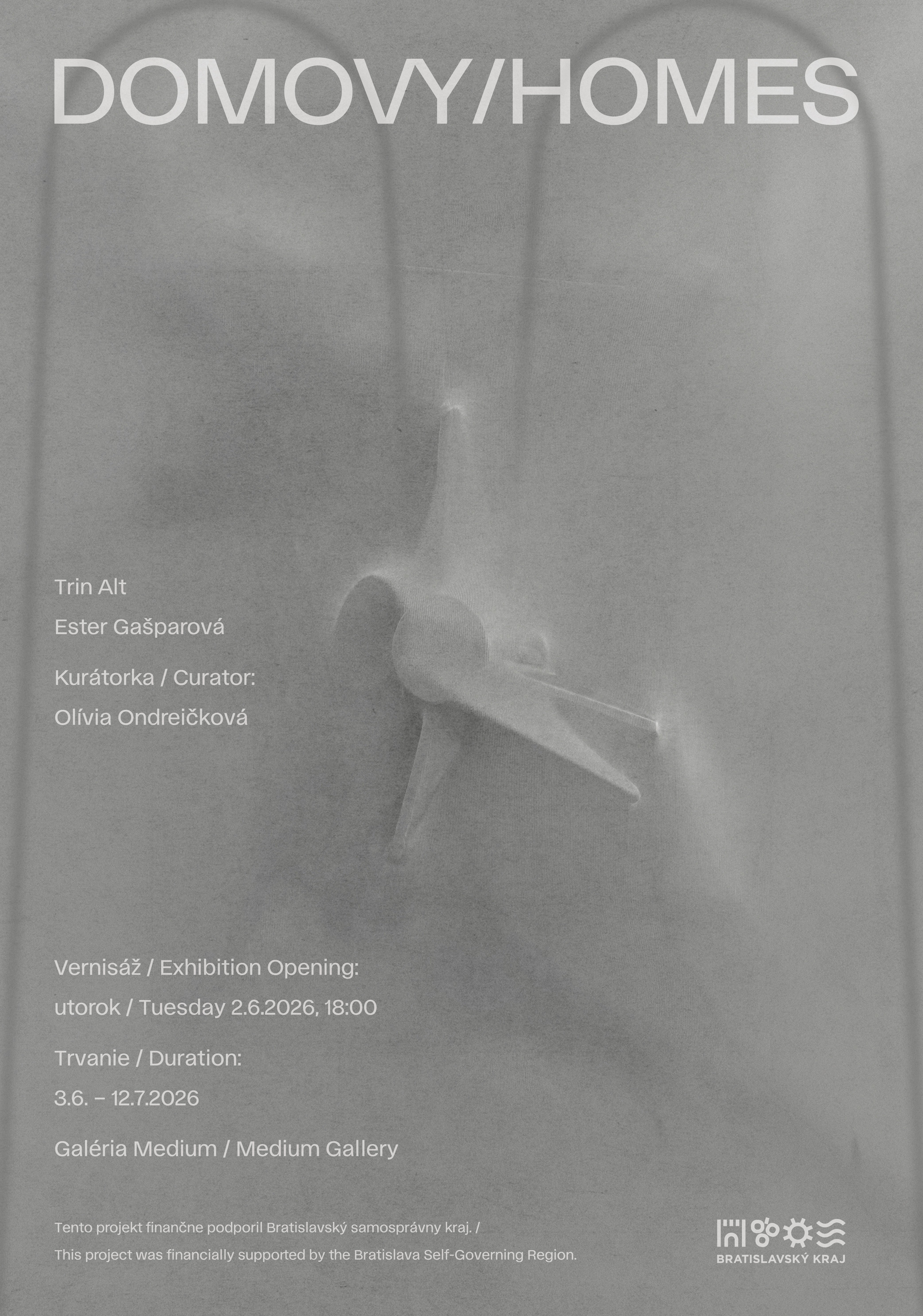
DOMOVY/HOMES
Trin Alt, Ester Gašparová
Kurátorka / Curator: Olívia Ondreičková
Vernisáž / Exhibition Opening: utorok / Tuesday, 2. 6.2026, 18:00
3.6. - 12.7.2026
Galéria Medium / Medium Gallery
----- EN version below ----
DOMOVY/HOMES kladie otázku zásadného významu pre našu generáciu: čo sa stalo s predstavou o „domove“ u tých, ktorí dospievajú vo svete poznačenom neistotou, nebezpečím a nezabezpečením? Táto „nesvätá trojica“ formuje to, čo sociológ Zygmunt Bauman nazval „tekutou modernitou“. V nej sa štruktúry, ktoré sa kedysi považovali za solídne – ako identita, komunita a práve aj domov – stávajú tekutými a neustále sa menia. V tomto kontexte už domov nie je pevne daným miestom, ale nestálym emocionálnym a politickým konštruktom, ktorý formujú osobné skúsenosti a spoločenské podmienky v kontexte súčasnej situácie.
Výstava spája umelca Trina Alta (nar. 2002) a umelkyňu Ester Gašparovú (nar. 2001), ktorí sa zaoberajú základnými otázkami spolupatričnosti. Alt vo svojich inštaláciách využíva objekty každodenného života, ktoré ako osobné, tak kritické voči neskorému kapitalizmu, otvárajú priestor na zamyslenie sa nad rozpadom ideálu domova. Gašparová si vyberá z aktuálnej politickej reality konkrétne elementy, ktoré narúšajú možnosť dôstojného života, aby ich následne pretvorila na podnet k účasti a reflexii v súčasnom spoločenskom dianí.
Výstava ako celok poukazuje na to, že intímne a politické sú úzko prepojené, a predstavuje domov ako neustále sa meniaci stav, ktorý formuje súčasnú predstavu o spolupatričnosti. Celá inštalácia ponúka pohľad na domov ako na fragmentované „puzzle“ – od jednotného k rôznorodému – ktoré spája svet vo vzájomných vzťahoch.
Trin Alt (nar. 2002, Maribor) je interdisciplinárny umelec, ktorý sa venuje kresbe a maľbe, pričom svoje diela často prispôsobuje konkrétnemu priestoru. Vo svojej tvorbe Alt analyzuje predmety každodenného používania a to, do akej miery formujú a zároveň spochybňujú našu identitu a rod. V neskorom kapitalizme sa vlastníctvo konkrétnych vecí priamo prejavuje v triede a v postavení. Alt spochybňuje konzumerizmus tým, že pripisuje dôležitosť často prehliadaným predmetom. V jeho najnovších dielach sú to príbory, skrutka alebo gombík. Dáva ich do popredia a ony sa tak stávajú symbolmi každodenného života.
Pracujúc s používanými predmetmi, ako sú periny, motocyklové prilby alebo vyradené kartónové krabice. Alt si znovu prisvojuje veci cudzích ľudí. V procese vytvárania koláží z autorských vzorov a obrazov na veciach z druhej ruky sa intímny predmet stáva verejným - ako v sérii s perinami s viditeľnými škvrnami tiel po predošlých majiteľoch.
V súčasnosti žije a pracuje vo Viedni. Je držiteľom štipendia Ministerstva kultúry Slovinska.
Ester Gašparová (nar. 2001, Banská Štiavnica) je vizuálna umelkyňa pracujúca predovšetkým v médiu sochy a inštalácie. Vo svojej práci sa venuje výskumu politickej symboliky, folklóru, rituálnych praktík a postsocialistických dejín. Prostredníctvom keramiky, betónu, ocele a industriálnych materiálov reflektuje vzťah medzi materiálovou krehkosťou a monumentalitou. Sleduje, akými spôsobmi sa ideologické formy uchovávajú, transformujú alebo postupne vyprázdňujú od svojho pôvodného významu. Historické odkazy vníma ako nestabilné rezíduá, prostredníctvom ktorých odhaľuje pretrvávanie moci, viery a kolektívnej pamäti.
Pomocou fragmentárnych štruktúr a symbolických foriem reflektuje, ako politické a kultúrne naratívy naďalej formujú súčasné identity a pocit spolupatričnosti. Jej inštalácie často vytvárajú napätie medzi trvácnosťou a rozpadom, čím poukazujú na nestabilitu ukrytú v kolektívnych dejinách a spoločenských systémoch.
V súčasnosti žije a pôsobí vo Viedni.
Tento projekt finančne podporil Bratislavský samosprávny kraj.
/
DOMOVY/HOMES asks a question of consequence for our generation: what happened to the imagination of “home” for those who came of age in a world marked by uncertainty, insecurity, and unsafety? This “unholy trinity” gives shape to what sociologist Zygmunt Bauman has called “liquid modernity.” Herein, structures once considered solid—such as identity, community, and, indeed, home—have become fluid and are constantly shifting. In this context, home is no longer a fixed place but a precarious emotional and political construct shaped by personal experience and social conditions under the aegis of contemporary conjunction.
The exhibition brings together artists Trin Alt (b. 2002) and Ester Gašparová (b. 2001), who touch on the fundamental questions of belonging. If Alt populates his installations with everyday objects that are both private and critical of late-stage capitalism, they open up a space to contemplate the ruination of the ideal of home. Gašparová takes concrete elements from contemporary political reality that upset the possibility of dignified life to subsequently convert them into a means of encouraging engagement with and reflection on current social dynamics.
Together, the exhibition reveals that the intimate and the political are tightly interconnected, presenting home as a continuously evolving condition that gives shape to the contemporary imagination of belonging. The complete installation serves as a proposition to view home as a fragmented puzzle—from singular to multiple—connecting the world in relation.
Trin Alt (b. 2002, Maribor) is an interdisciplinary artist working in the medium of drawing and painting often arranged in a spatial setting. In his practice, Alt analyses the objects of daily use and how much they structure and defy our identity and gender. In late-stage capitalism possessing specific things translates directly into class and status. He questions consumerism by giving importance to often omitted objects. In his latest works it is cutlery, a screw, or a button that are given importance and become symbols of daily existence.
Working with previously used objects like duvets, motorcycle helmets or discarded cardboard boxes Trin reestablishes ownership over strangers’ belongings. In the process of collaging self-applied patterns and images onto second-hand things an intimate object becomes public, like in the duvet series where stains left by bodies of previous owners are clearly visible to the public.
He is currently living and working in Vienna and is a recipient of a scholarship from the Ministry of Culture in Slovenia.
Ester Gašparová (b. 2001, Banská Štiavnica) is an artist working primarily with sculpture and installation. Her practice is rooted in research of political symbolism, folklore, ritual practices, and post-socialist histories. Employing ceramics, concrete, steel, and industrial materials, she explores the tension between material fragility and monumentality. She examines the ways in which ideological forms are preserved, transformed, or gradually emptied of meaning over time. Her work approaches historical references as unstable residues, foregrounding the afterlives of power, belief, and collective memory.
Through fragmented structures and symbolic forms, Gašparová reflects on how political and cultural narratives continue to shape contemporary identities and experiences of belonging. Her installations often evoke a persistent tension between permanence and collapse, revealing the instability embedded within collective histories and social systems.
She is currently living and working in Vienna.
This project was financially supported by the Bratislava Self-Governing Region.
Portál www.kamdomesta.sk nie je organizátorom uverejňovaných podujatí a preto nezodpovedá za zmeny uskutočnené organizátormi. Odporúčame preveriť si vopred termín a čas konania podujatia priamo u organizátora. Na niektoré akcie je potrebné sa prihlásiť vopred.


